
How AFR and Renewable Energy Can Reduce GHG Emissions in the Cement Industry?
The cement industry is one of the most carbon-intensive sectors in the world. Producing one tonne of cement releases significant greenhouse gas emissions (GHG), primarily due to the combustion of fossil fuels in kilns and the electricity used for grinding, material handling, and auxiliary processes. As global climate targets become stricter and carbon reporting frameworks evolve, cement companies are increasingly exploring ways to reduce their greenhouse gas emissions intensity (GEI). Two of the most practical and immediately deployable solutions are Alternative Fuels and Raw Materials (AFR) and Renewable Energy (RE).
Both strategies target different emission sources within cement manufacturing and together can significantly reduce the overall carbon footprint of cement production.
Understanding Where Cement Emissions Come From
Before exploring solutions, it is important to understand the main sources of emissions in cement manufacturing.
| Emission Source | Description | Share of Total Emissions |
| Process emissions | CO₂ released from limestone calcination in the kiln | ~60–65% |
| Fuel combustion | Burning coal, petcoke, or other fossil fuels to heat the kiln | ~25–30% |
| Electricity consumption | Power used for grinding, crushing, conveyors, and fans | ~10–15% |
Since process emissions are chemically unavoidable, many decarbonisation efforts in the near term focus on reducing fuel-related and electricity-related emissions, where AFR and renewable energy play a critical role.
Alternative Fuels and Raw Materials (AFR)
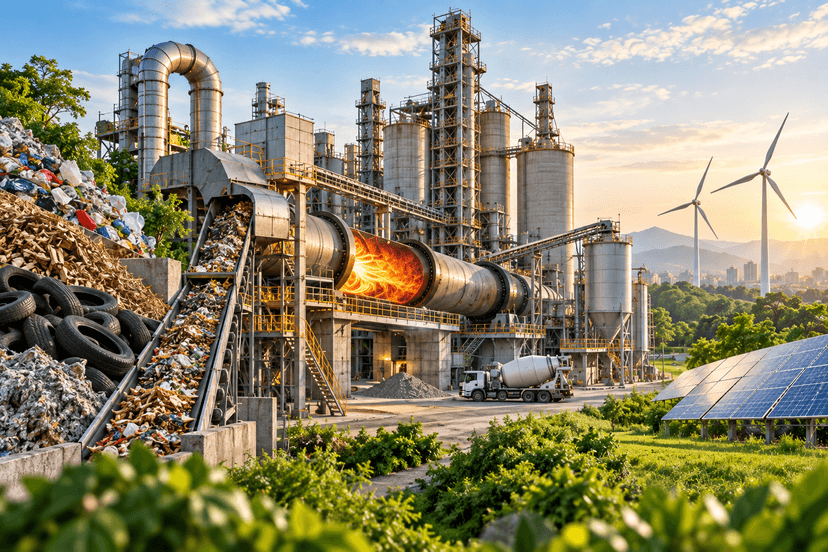
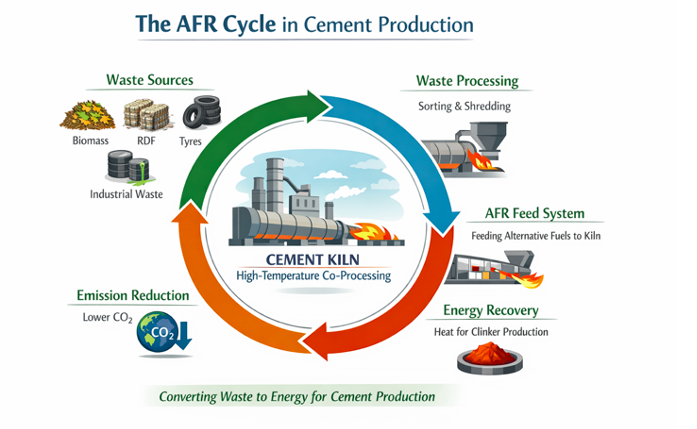
Alternative Fuels and Raw Materials refer to waste-derived fuels and industrial by-products used to replace conventional fossil fuels in cement kilns. Cement kilns are particularly suitable for co-processing waste because they operate at extremely high temperatures (up to 1450°C), ensuring complete combustion and safe disposal of waste materials.
Common AFR sources include Refuse Derived Fuel (RDF) from municipal solid waste, biomass residues such as rice husk, sawdust, and agricultural waste, used tyres and rubber waste, industrial waste such as solvents or sludge.

How AFR Reduces Emissions
1. Replacing fossil fuels
Coal and petcoke are highly carbon-intensive fuels. Substituting them with waste-derived fuels reduces the amount of fossil carbon entering the kiln.
2. Utilising biogenic carbon
Biomass-based fuels contain carbon that is part of the natural carbon cycle, which lowers net emissions compared to fossil fuels.
3. Avoiding landfill emissions
Using waste as fuel prevents methane emissions from landfills, contributing to broader climate benefits.
AFR Use in India
Indian cement companies are gradually increasing their Thermal Substitution Rate (TSR)- the percentage of heat generated from alternative fuels.
| Country | Typical TSR |
| Europe | 40–60% |
| Japan | ~60% |
| India | ~4–8% (growing rapidly) |
The relatively low TSR in India represents a significant opportunity for emissions reduction if waste supply chains, regulations, and preprocessing infrastructure improve.
Renewable Energy in Cement Plants
The cement industry is one of the most energy-intensive sectors in the world. While much attention is often given to emissions from clinker production and fuel combustion, electricity consumption in cement plants also contributes significantly to greenhouse gas emissions. Grinding operations, conveyors, fans, and other auxiliary systems require large amounts of electricity. When this electricity comes from coal-based power grids, it increases the overall carbon footprint of cement production.
As the industry works toward decarbonisation, integrating renewable energy sources into plant operations has become an important strategy for reducing emissions, particularly Scope 2 emissions associated with purchased electricity. Many cement companies are now investing in renewable power solutions to make their operations more sustainable while also improving energy security and cost stability.
How Renewable Energy Reduces Emissions
The adoption of renewable energy helps cement plants reduce their carbon footprint in several ways.
1. Replacing Fossil-Based Grid Electricity
In many regions, electricity grids are still dominated by coal-based power generation. When cement plants switch to solar or wind power, the carbon intensity of the electricity they consume drops significantly. This reduces the indirect emissions associated with plant operations.
2. Reducing Scope 2 Emissions
Under greenhouse gas accounting frameworks, emissions from purchased electricity are classified as Scope 2 emissions. By sourcing electricity from renewable energy systems, cement companies can directly lower these emissions and improve their environmental performance.
3. Improving Long-Term Energy Cost Stability
Renewable energy also provides economic benefits. Unlike fossil fuels, which are subject to market volatility and supply risks, solar and wind power typically operate with predictable long-term costs. This helps cement companies stabilise their energy expenditures and manage operational risks.
Many cement companies in India already use captive solar and wind power through open-access agreements, which allows them to procure renewable energy from independent power producers.
Combined Impact on Cement Decarbonisation
When implemented together, AFR and renewable energy can significantly reduce the carbon footprint of cement manufacturing.
| Measure | Emission Reduction Area | Potential Impact |
| AFR | Scope 1 (fuel combustion) | Reduces fossil fuel use in kilns |
| Renewable Energy | Scope 2 (electricity) | Decarbonizes plant electricity consumption |
| Waste Heat Recovery | Scope 2 | Generates low-carbon electricity internally |
While these solutions cannot eliminate process emissions from limestone calcination, they address nearly 40% of cement sector emissions, making them critical short- to medium-term decarbonisation strategies.
AFR and RE in the Indian Cement industry context
The Indian cement industry is among the most energy-intensive industrial sectors and accounts for a significant share of industrial greenhouse gas emissions. Two important strategies adopted by cement manufacturers to reduce their carbon footprint are Alternative Fuels and Raw Materials (AFR) and Renewable Energy (RE).
Alternative Fuels and Raw Materials (AFR) refer to the use of waste-derived fuels and materials such as refuse-derived fuel (RDF), biomass, municipal solid waste, and industrial residues in cement kilns. Cement kilns operate at extremely high temperatures (around 1450 °C), making them well suited for safely co-processing waste. AFR replaces traditional fossil fuels like coal and petcoke, thereby reducing direct Scope 1 emissions and diverting waste from landfills. While the global cement industry has achieved thermal substitution rates above 20–25%, India’s AFR utilisation remains relatively low, typically around 5–7%, due to constraints in waste segregation, supply chains, and regulatory approvals. However, several leading cement companies are investing in pre-processing facilities and partnerships with municipal bodies to increase AFR usage.
Renewable Energy (RE) is another key lever for decarbonisation. Cement plants consume large amounts of electricity for grinding, crushing, and material handling. By adopting renewable sources such as solar, wind, and waste heat recovery (WHR) systems, companies can reduce Scope 2 emissions associated with grid electricity. Many Indian cement producers have already integrated captive solar and wind plants as well as WHR systems that generate power from kiln exhaust gases.
| Strategy | Purpose | Emission Impact |
| AFR (waste-derived fuels) | Replace coal/pet coke in kilns | Reduces Scope 1 emissions |
| Biomass co-processing | Renewable thermal fuel | Low-carbon energy input |
| Waste Heat Recovery (WHR) | Generate electricity from kiln exhaust | Reduces grid electricity use |
| Solar / Wind power | Clean electricity supply | Reduces Scope 2 emissions |
Challenges in Scaling AFR and Renewable Energy
Despite their significant potential to reduce emissions, several barriers still limit the large-scale adoption of Alternative Fuels and Raw Materials (AFR) and renewable energy (RE) in the cement industry. One of the key challenges is the limited availability of well-segregated waste and reliable supply chains, which restricts the consistent use of waste-based fuels. In addition, regulatory approvals for waste co-processing can often be complex and time-consuming, slowing down the integration of AFR in cement kilns. High logistics and transportation costs for moving waste fuels from collection points to cement plants further add to operational constraints. On the renewable energy side, intermittency issues associated with solar and wind power can create challenges in maintaining a stable energy supply for continuous industrial operations. Furthermore, grid infrastructure limitations and regulatory barriers related to open-access renewable procurement can restrict cement plants from sourcing renewable electricity at scale. Addressing these challenges will require coordinated efforts between industry stakeholders, government agencies, and waste management systems to strengthen supply chains, streamline regulatory frameworks, and improve infrastructure for both waste utilisation and renewable energy integration.
The Road Ahead
The cement industry will play a crucial role in achieving global climate targets. While long-term technologies such as carbon capture and low-carbon clinker are being developed, AFR and renewable energy represent practical solutions that can be implemented today.
By increasing the use of alternative fuels and expanding renewable energy procurement, cement companies can significantly lower their greenhouse gas emissions intensity while moving toward a more sustainable and circular industrial system.