
Global climate policies are increasingly shaping international trade. One of the most significant developments in recent years is the Carbon Border Adjustment Mechanism (CBAM) introduced by the European Union (EU). For industries such as iron and steel, which are both energy-intensive and heavily traded globally, CBAM is rapidly becoming a major regulatory and business challenge.
For Indian steel producers exporting to Europe, understanding CBAM reporting requirements is no longer optional, it is essential for maintaining market access and competitiveness.
The Carbon Border Adjustment Mechanism (CBAM) is a policy introduced by the European Union to place a carbon price on imported goods based on the emissions generated during their production. The goal is to ensure that imported products face similar carbon costs as those produced within the EU under the EU Emissions Trading System (EU ETS).
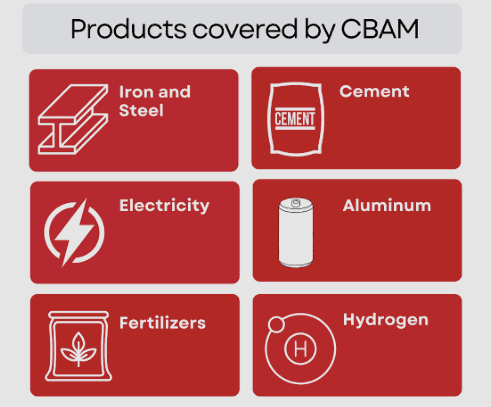
The mechanism aims to prevent “carbon leakage,” where companies shift production to countries with weaker climate regulations to avoid carbon costs. CBAM currently covers 6 carbon intensive sectors. These sectors account for a large share of emissions from industrial production in the EU.
| Sector Covered by CBAM | Examples of Products |
| Iron and Steel | Steel sheets, pipes, nuts, bolts |
| Cement | Clinker and cement products |
| Aluminium | Primary aluminium |
| Fertilisers | Ammonia-based products |
| Electricity | Cross-border power imports |
| Hydrogen | Emerging low-carbon fuel |
Table 1: Sectors covered under CBAM
| Phase | Period | Requirement |
| Transitional Phase | 2023–2025 | Importers must report embedded emissions in products |
| Definitive Phase | From 2026 | Importers must purchase CBAM certificates linked to emissions |
Table 2: CBAM Implementation timeline
During the transitional phase, companies exporting goods to the EU must report the carbon emissions embedded in their products, but they do not yet have to pay a carbon cost. From 2026 onward, importers will have to buy CBAM certificates that correspond to the carbon emissions associated with those products.
What Does CBAM Reporting Include?
The Carbon Border Adjustment Mechanism (CBAM) reporting framework focuses on calculating and disclosing the embedded greenhouse gas emissions associated with goods exported to the European Union. For sectors such as steel, cement, aluminium, fertilizers, electricity, and hydrogen, exporters must report detailed information on the emissions generated during the production process. Typical CBAM reporting requires plant-level production data (e.g., total steel production), energy consumption data including electricity and fuel use, and process emissions arising from activities such as ironmaking or clinker production. These inputs are used to determine the emission intensity, usually expressed as tonnes of CO₂ emitted per tonne of product. To ensure transparency and credibility, the reported data must undergo third-party verification by accredited auditors. If verified plant-specific emissions data is not available, the European authorities may apply default emission values, which are generally set conservatively and tend to be higher than the actual emissions of efficient plants. As a result, exporters relying on default values may face higher carbon costs under CBAM, making accurate monitoring, reporting, and verification (MRV) systems essential for maintaining competitiveness in EU markets.
Steel Produced Outside EU
│
▼
Embedded Carbon Emissions
│
▼
CBAM Reporting to EU
│
▼
Carbon Cost Calculation
│
▼
CBAM Certificates Purchased
│
▼
Steel Allowed into EU Market
Figure 1: How CBAM works in trade
Why CBAM Is Relevant for Indian Steel Players?
India is one of the largest steel producers in the world, and the EU is an important export market. As a result, CBAM has major implications for the sector.
The iron and steel industry accounts for about 90% of India’s exports that fall under CBAM coverage, making it the most exposed sector to the policy. This means that changes in EU climate policy could significantly affect Indian steel exports.
Potential Impact on Indian Steel Industry
1. Additional Carbon Costs
From 2026 onward, Indian steel exported to the EU will face additional carbon-related costs based on emissions embedded in production.
Some estimates suggest that carbon charges could increase export prices significantly depending on emission intensity.
2. Reduced Export Competitiveness
Indian steel production often has higher emission intensity compared to EU benchmarks.
| Region | Average Emissions (tCO₂ per tonne of steel) |
| EU benchmark | 1.37 |
| Typical Indian plants | 2.1 |
This emissions gap translates directly into higher carbon costs under CBAM.
3. Impact on Profit Margins
Exporters may need to reduce prices or absorb carbon costs to remain competitive in EU markets. Some estimates suggest exporters might need to cut prices by 15–22% to offset CBAM costs.
4. Compliance and Data Challenges
CBAM requires detailed plant-level emissions data, which can be difficult for some companies to compile.
Challenges include:
- Lack of verified emissions data
- Complex reporting frameworks
- High compliance costs for smaller firms
These challenges may disproportionately affect small and medium steel producers.
| Strategy | Benefit |
| Energy efficiency improvements | Lower emission intensity |
| Electric Arc Furnaces (EAF) | Increased scrap-based production |
| Green hydrogen steelmaking | Long-term decarbonisation pathway |
| Renewable electricity use | Reduced indirect emissions |
| Carbon accounting systems | Improved CBAM compliance |
Table 3: Opportunities for the Indian Steel Sector
Way forward
CBAM represents a new phase where climate policy and global trade are increasingly interconnected. For Indian steel exporters, the mechanism introduces both regulatory pressure and strategic opportunity.
Companies that invest early in carbon measurement, energy efficiency, and low-emission technologies will be better positioned to compete in markets where carbon intensity increasingly determines trade competitiveness.
In this evolving landscape, CBAM reporting is not just a compliance exercise—it is becoming a key driver of industrial decarbonisation and global market access for the steel industry.